Tuesday, July 24, 2012

IMMOBILIZED WITHOUT SWOT


Here comes the highlight of this module, the painstaking process of doing the SWOT analysis.  I am sure there’s nothing there is to be a successful DEVCOM practitioner without the knowledge of SWOT.  SWOT serves as reinforcement in quantifying your planned project, seeing the opportunity and the unfeasibility.

It is like doing your personal life plan on some major things and all you could ever thought of is get a pen and write down the pros and cons before you could come to a final decision.

The presence of SWOT in any project you would like to make gives you a fine view of the paramount actions one should necessarily take.  Sufficient knowledge of the positive and negative involving the classification of the internal and external matters affecting the success of the project is chiefly the most important thing one should be keen about in commencing the plan.

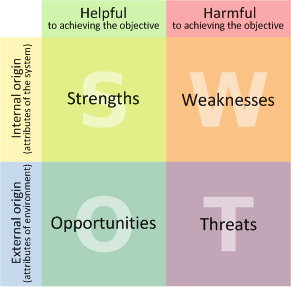
SWOT is the acronym for Strengths, Weaknesses, Opportunities and Threats.  According to vebsar.com, “Strengths are the attributes of a person or a company that are helpful in achievement of the objective. Weaknesses are the attributes of the person or company that are harmful in achieving the objective. Opportunities are the external conditions that are helpful in achievement of the objective. Threats are the external conditions which could do damage to the objective.”

SWOT analysis serves as a useful tool for preparing or amending plans, solving problems and making decision in a project.  Just like huge businesses that have turned to SWOT strategy in their business venture -- in any plight or business success they underwent, they just simply SWOT it.  I’m certain it will serve us the same thing or else our project would just be as immobilize and worthless.


Photo Credit:

Reference:

Tuesday, July 17, 2012

A DEVCOM CATALYST—JUST WHAT I AM

Varied societal issues from poverty, unemployment, malnutrition, environmental degradation, etc. have been a universally growing epidemic in the past decades. The sad reality is, Philippines is among the most affected. Our adversities leave us feeling thankless, helpless, and hopeless. Many of us move on to other countries hunting for a more promising future so we can hand in some help to our families back home. We were hopeful for a happy ending to a never ending country’s privation.

I was a graduate of Office Management, then took English Education and venture the field of teaching English in Thailand. Little love is all I have got at first for my teaching profession. I have felt some degree of aversion towards Thais' nationalistic nature and hesitation to improving their English language. But when I end up being a Literacy Teacher in a bilingual school did I gradually realize the worth of my profession. And that's how my love story with DEVCOM begun. I'm more than happy this will be my fourth year in the Reading Project, designing and improvising the program's strategies to aid each reading level of our students. Our project has served its purpose and parents were more than happy of their children's attainment in the academic context as a whole.

They said that we, humans, are naturally born DEVCOM advocates, although many have not actively participated in public programs promoting helpful ways to alleviate existing issues, many have endeavored enough to improve their own personal lives and saving themselves from issues that affect them (like poverty). But if I have to look at myself in the presence of these societal issues, I would say with pride I have started being a catalyst for greater change a long time ago. I have fallen in love with education. Just like the project I'm working presently, I would strongly support any development for education concerning issues that would cause a dire change to any academic environment. And my love story with DEVCOM still continues with all its ups and downs.

Call me a catalyst for development, I'm born to be one among you.

Friday, July 13, 2012

ENGLISH READING DILEMMA IN THAILAND BILINGUAL SCHOOLS

BACKGROUND
For closely four years now, I have been a part of the literacy education focusing the development of the reading skills of our Thai and multicultural students in our bilingual school. Less knowledge in reading is a widely known problem you get to meet in any Thai institution.

English reading skill is an important skill to master.  It plays the most crucial role for Thai and multinational students in their academic context.  But unfortunately, most Thai students feel about learning English the way they feel about a dentist appointment. For some it must feel like a tooth-pulling appointment. A third-year student at Srinakharinwirot University said:

It is commonly known that English is a fearsome language among Thais. Certainly their aversion towards English could not help them at all in learning the language.  One main reason for their poor performance is not their fear of learning the speech but the miserable instruction that they have endured without any apparent benefit, which also might have contributed to their fear of the language in the first place.

Thais spent a luxury in education with high hopes for the English fluency of their children. However, the return keeps them desperate and keeps them striving to test out other schools and languages centers. No one can help them better than the school can. Thus, schools should have sufficient knowledge with regards to BASIC LEARNING--learning to read. Conversational English has been the common practice in any Thai schools, thinking it is the foremost thing they should learn.   Many Thai institutions fail to recognize the worth of learning READING first.   Basic may sound an effortless thing. But dealing with the students who are barely able to read is similar to teaching a baby how to walk. It takes goals coupled with passion to persist doing it whatever the cost.

This study centers mainly on the INSTRUCTIONAL READING and not the LIBRARY READING where two have great major differences.  According to our school librarian, Library Reading is more personal when an individual has freedom to read whatever he likes, to skip pages, to read the same material from time to time, or to just look at pictures while Instructional Reading is a part of the curriculum.  It has an aim of developing the individual’s reading skills with specific literacy level of his attained skill.  And this is one thing pertinent to this implementation of the Reading Program in respective Thailand Bilingual schools.

Campaign Purpose Campaign Focus Rationale for Focus
English Reading Program in Thai Bilingual Schools Encourage Thai bilingual school principals to implement English Reading Program in their respective schools. •To conduct seminars to school principals and teachers alike the importance of English Reading Program for Thai and multicultural students’ educational context.
•To distribute leaflets to parents informing the new program the school will launch.
•To advertise the program on school websites using pictures or videos with regards to the importance of Reading in every student’s learning.

SWOT ANALYSIS
STRENGTHS WEAKNESS OPPORTUNITIES THREATS
•Support from Thailand’s Ministry of Education in incorporating Reading Course as a part of the school curriculum.

•School funds for categorized books to specific level group of readers.

•Qualified teachers to facilitate in setting up the literacy program.
•Qualified librarian to aid in classifying appropriate books for the reading echelon.
•Other nationalistic Thai school officials’ aversion of the changes in their Thai education curriculum could cause disapproval of the program.


REFERENCES:
http://www.journal.au.edu/abac_journal/2010/may2010/article3.pdf
http://asiancorrespondent.com/78647/thai-education-failures-part-4-dismal-english-language-education/

ON MEMES: DEVCOM PRACTITIONER, A MARKETER AT THE SAME TIME

A part of the Development Communication Practitioner’s work is our knowledge in marketing strategies to attain our purpose.  And the idea of MEME has emerged as one effective approach in promoting our service in any society. 

The most essential thing is to understand how a meme should help us in our field of work.  Memes are all over the internet these days.  We have the blog memes, the facebook memes, and many companies greatly value the tactics of using memes in marketing their products.  But what exactly is a MEME, anyway?  Let's start off with a simple definition based on our techy world today. A meme is quite simply a concept, behavior, or idea that spreads, usually via the internet. A meme most commonly manifest itself in a visual such as a picture or a video, but it can also take the form of a link, hash tag, a simple word or phrase (e.g. an intentional misspelling), or even an entire website. And the truly successful memes? They spread like wildfire, and they're popularly known.1

It is said that certain ideas or information will not be considered meme until it caused someone to redo it, to adopt and be totally persuaded by it.  In short, all transmitted information is “memetic.”  As for marketing, it is like using advertisements using catchy slogans with catchy lines, jngles with catchy tunes, eye catching icons, really cool inventions and fashion trends are just a few kinds of memes.2

According to Jamie Glass, “Memes create lasting impressions. They are the words people will carry with them and tell others about you and your business.  Marketers often suggest that it takes seven times before a message really sticks.  It’s called the Rule of Seven. Will your meme be repeated by every person you tell seven times or more?  If so, then you have truly created an effective, viral marketing meme!”3

MEME connotes INFLUENCE—persuading and encouraging the society to the certain behavior and practice you’d like them to act on. Now that’s pretty obvious why a Development Communication Practitioner should be a marketer at the same time. Acquiring a marketing mind always matters in giving leverage to our scheme and how we would like our scheme to go viral.  By doing so, we would take effect in giving our society the development we deem possible.

REFERENCES:
1.  http://blog.hubspot.com/blog/tabid/6307/bid/33197/10-Popular-Memes-Masquerading-as-Marketing-Campaigns.aspx#ixzz1yZZKdEuC
2. http://www.melovillareal.com/2008/08/06/importance-of-memes-in-achieving-marketing-results/
3. http://projecteve.com/profiles/blogs/what-is-your-marketing-meme

Wednesday, July 4, 2012

SOCIAL MARKETING ON SOCIETY’S WELFARE


Typically, MARKETING as we view it is about activities and strategies in making and selling products to consumers while making profits for the companies at the same time.  But then, it isn’t all that since numerous companies nowadays sell not so helpful products in the market that could somehow harm society’s welfare.   Their companies could have gained profits in billions but have badly affected a huge population as well.  Renowned examples for this are:  cigarettes and alcohol.

That’s why understanding “SOCIAL MARKETING” is one crucial thing a DEVCOM practitioner should be keen about, as we should put into great consideration that the services or the products we should publicize are beneficial for the society.  Below are the things I would like my potential partner to think about on working out with our program.

WHAT IS SOCIAL MARKETING?
Other definition of social marketing is not-for-profit marketing since its main focus is on doing social good to achieve specific behavior goals with specific audiences pertaining to relevant programs such as (health, sustainability, recycling, etc.)  Take it for instance; the campaign that persuades and reminds people to get regular check-ups and vaccinations is a program encouraging a long-term behavioral change and is considered social marketing rather than a 3-month marketing campaign on H1N1 vaccination.  The main thing about social marketing is the sustainability of the said program you are promoting for the wellbeing of everyone.

HOW DOES SOCIAL MARKETING DIFFER FROM COMMERCIAL MARKETING?
Wikipedia defines that the primary aim of social marketing is "social good", while in "commercial marketing" the aim is primarily "financial". This does not mean that commercial marketers cannot contribute to achievement of social good.
A commercial marketer selling a product may only seek to influence a buyer to make a product purchase.

Social marketers, dealing with goals such as reducing cigarette smoking or encouraging condom use should have goals for long-term behavioral change in target population.

According to Stephen Dahl, one of the main points for commercial marketing is the creation and exchange of products that people want and need, for social marketing while that may be true in the long run, it may not be so in the short term.

I would say that in commercial marketing, we were provided options.  Like the healthy and unhealthy food.  Take the example of consumers who think they need a healthy diet and would go for bananas, apples, grapes, etc.  However, there are also a lot of consumers who would opt for unhealthy food.  In that sense, commercial marketing supplies what the consumer needs and wants at the same time.

Social marketing is pretty different: In social marketing we would be trying to influence those people that want unhealthy food to switch to healthy food with lesser concerns to those who already eat healthy.  This also explains why it is a lot easier to be a commercial marketer: After all commercial marketing is like bringing what someone wants when they want it in the way they want it - while social marketing really is about convincing someone that a particular behavior is bad/unhealthy/undesirable and to do something that he/she may not originally want to do.

WHAT SOCIAL ISSUES CAN BENEFIT FROM SOCIAL MARKETING?
Many marketing professionals provide services to some organizations attending to societal issues.  And these are some of the social issues that could benefit from the strategies of social marketing.  
Public Health Issues such as (drug, alcohol, tobacco)
Environmental Protection such as (litter, water and energy conservation, Waste Reduction:  Reuse, recycle, reduce; air pollution from automobiles)
Injury Prevention such as (drinking and driving; seat belts, sexual assault, drowning, fires, falls, etc.)

Having good knowledge on our responsibilities is all a DEVCOM Practitioners need to have to do our duties for the community and how we will be able to carry out those goals we would like to attain for the betterment of the community.  After all, our main duty is “TO BE BETTER IN DOING GOOD”


REFERENCES:


Tuesday, July 3, 2012

LEARNING BLOG 3: SOCIAL MARKETING ON READING PROGRAM IN THAILAND BILINGUAL SCHOOL


After being able to grasp the concept of a social marketing career and how it mainly focuses for the “social good”, I realized it’s NO EASY JOB to undertake grave societal issues and influence behaviors for progress.  Simply because it’s not like commercial marketing when you market diverse options for the consumers and it’s up to them to decide on the product or services that could either benefit them or harm them.  

This topic has been so far one of the most that interests me.  I value most of my life from my education.  I owe most of my attainments to my education.  What I am now and where I am now is all because how learning has helped me to be.   So if we would address about societal issues, I would likely advocate one of the major concerns in the field of education where a social marketing expert will exercise his approach.

I have been working in Thailand for five years now and the general problem any Thai school deals with is the enormous number of students who are barely able to read from Grade 1 to High school.  Now, isn’t that alarming?  And we can’t just sit and agonize about it.  It’s a serious matter educationalist (or anyone enthusiastic to start up a program) should fix.  If our children are our future, I’m afraid it’s not viable to see them a part of a bright future if we don’t lend them a hand to the READING DILEMMA they’re currently into.

Despite of this existing problem, our school, where I’m presently working, are still hopeful for some answers.  Hence, we put up a Literacy Program to attend to the reading disabilities of our students.  Everybody was pleased with the result.  The kids’ improvement in reading has helped them with their academic as a whole. We received positive feedbacks from the parents about the program.  Consequently, the reading program continues to operate.  And it’s been ongoing for five years now.

Social Marketing indeed made the difference.  It sometimes oblige us to do what we think is not possible.  However, it only takes devotion to affect the impossible POSSIBLE.  One author says, IMPOSSIBLE itself says I’m Possible.